Happy New Year!
Here's hoping all of your resolutions stick.
And if they don't, well...

an open and affirming community of faith
n open and affirming community where faith is questioned and formed, as relationships are made and upheld.
Here's hoping all of your resolutions stick.
And if they don't, well...


Jai Husband is leading a new young adult class on Sunday mornings at 9:45 a.m., upstairs in the education building. The class will be exploring the Gospels and what God means in the context of everyday life.
Come on out!
By Derek Penwell
When I teach Theodicy (i.e., the problem of evil and suffering) to my university students, I start out by playing a game of hangman. I draw out a random number of blanks, and start asking for letters.
“S? No.”
“R? Nope.”
“E? Sorry.”
I doesn’t take long before I have a couple of blanks filled with X or Q. I might randomly add another space or two. This usually brings cries of protest.
Finally, the figure fills out. They lose.
Now they’re really howling. “There isn’t any set of English words with those letters!”
“Do you want to know what the phrase is?” So, I start writing on the board: Lawlessness and Chaos.
Sheer frustration. Somebody, usually earnest and sitting in the front row, someone used to school making sense, yells out, “That’s not fair.”
So, I ask, “How do you like it when somebody doesn’t follow the rules? Hard to play the game when someone keeps changing them, isn’t it?”
They don’t like it … not one bit.
But then again, nobody does, do they? We like consistency and predictability. We don’t like the thought that lawlessness and chaos might insinuate themselves into the otherwise stable taken-for-grantedness of our lives.
One of the reasons, people have such a difficult time with the question of evil and suffering is that it usually represents a deviation from the way our middle class American lives are lived.
You turn on your T.V. set one Friday morning, getting ready for Christmas, planning your last-minute shopping, when a reporter announces that some guy has walked into an elementary school in Connecticut and mercilessly slaughtered twenty six year-olds. Shock. Anguish. Outrage.
But people die all the time, right? Even children. What’s so different about this?
The difference is that we don’t want to live in a world where it’s possible for grade school kids to be murdered in the sanctuaries we’ve built for their education. Too scary to contemplate.
So, what do we do? We start looking for someone or something to blame.
Inadequate security. Proliferation of weapons. Poor mental health care. Violent video games.
We’ve got to find some culprit, since the thought that sometimes awful things happen and that, no matter how well we prepare, we can’t prevent those awful things is just too horrifying to ponder. So, we look to see where the rules have been broken.
The problem of evil raises the issue of anomie (lawlessness). We feel as if no one is in charge, as if there are no rules, and therefore, no meaning. Even the way we phrase it (“the problem of evil”) implicitly suggests our belief that something has gone wrong—that something isn’t as it should be. It suggests that evil is somehow unnatural, a breakdown in the system.
But, even more than evil, the real culprit is anomie. Even if the outcome doesn’t amount to evil and suffering, human beings generally don’t like surprises. We like predictability. The idea of change is enough to set our teeth on edge. If I put the toe-nail clippers in the medicine cabinet, I want to know that the next time I need them, they’ll be right where I go to look.
“Well, did you look in the cupboard?”
“No. Why would I look there? I put them in the medicine cabinet.”
“You’ve got to broaden your field of vision. You can’t just look in one place and expect to find something.”
“I can expect to find something where I put it, because that’s why I go to the trouble of putting it there in the first place—so, I don’t have to have a conversation with a fifteen year-old at 7:45 in the morning about where my dang toe-nail clippers are!”
Stable. Predictable. Is that too much to ask?
Unfortunately, stable and predictable are much harder to find than we realize. The world is changing … rapidly. Things are growing more complex, less predictable all the time. It’s scary.
And communities are just as likely as individuals to look for stasis in a world undergoing constant transformation. In fact, for a lot of reasons, communities are often less open to change, more resistant to playing by a different set of rules than individuals.
I’m thinking specifically of churches—both congregationally and denominationally.
Seth Godin wrote an interesting blog post the other day about paracosms. Paracosms are highly detailed and absorbing imaginary worlds—think Middle Earth or Narnia. One of the notable differences with paracosms is that they operate under a different set of rules from the ones we live under. Talking animals. Dragons. Magic. Invisibility.
These paracosms are useful to child developmental psychologists in helping them to understand how children confront the anomie represented by a death or tragedy experienced in early childhood. Paracosms help people sort out and understand their loss.1
Paracosms, elaborate and detailed worlds that allow for a rearranging of constituent parts into new possibilities, are particularly helpful in allowing children to orient “themselves in reality.”
With Seth Godin, I find the idea of paracosms to be an interesting notion for creatively attacking the uncertainty of a changing world. The church, which has undergone its own share of tragedy and loss over the past forty years, might do well to begin to play with paracosms.
What would a perfect world look like?
How would the church contribute to the shaping of such a world?
If all the old rules about what church should look like were no longer in place (e.g., buildings, Sunday mornings at 11:00, denominational headquarters, Sunday School, parking lots, copy machines, bulk mailing permits, etc.), how might congregations and their denominational counterparts on the regional and national levels embody the reign of God in ways designed to inhabit a new world?
Let’s get really crazy:
Would ordained clergy still look the same? Would we even have clergy?
How about the laity? What if the laity were the radical ones pushing to respond to the demands of the new world?
Would this paracosm require that the bulk of the people who spoke for God be male, middle class, and white?
What if this new world were so upside down that because of the population make up, middle class white guys were the last ones seated at the trough instead of the first ones?
What if worship were conceived as something we did on our feet, searching out people where they live—and not on our butts, waiting for people to come to where we live?
What if this new world required that we have no assets at all? How would the church live out its witness?
I know, all that stuff is fantastical. You start screwing around with the rules and the hoi polloi get reeeeeally anxious. Anomie. Lawlessness. Chaos.
“You can’t have a church without all that stuff!”
Why not? Maybe the future that’s unfolding, this new world, requires a whole different set of rules that render the old assumptions about what’s necessary obsolete?
Seth Godin writes:
The most effective, powerful way to envision the future is to envision it, all of it, including a future that doesn’t include your sacred cows. Only then can you try it on for size, imagine what the forces at work might be and then work to either prevent (or even better, improve on) that future and your role in it.
We’re followers of Jesus, given the responsibility of proclaiming a new world—one in which God reigns, and not the powers and principalities of this present age.
Change ought not to frighten us; that’s what we’re here to announce … for Christ’s sake.
Morrison, Delmont C. and Shirley L., Memories of Loss and Dreams of Perfection: Unsuccessful Childhood Grieving and Adult Creativity. Baywood, 2005. ↩

This year we have adopted individuals from The Family Scholar House.
The Family Scholar House is a program in Louisville that gives single-parent students the support they need to earn a four-year college degree.
The angels will be placed on the tree in the Gathering Area on Sunday, December 1st and all gifts must be returned to the office no later than December 10th.
If you would like to pick an angel this Sunday please see Jennifer Vandiver.

"From the very beginning, Jesus indicated that the reign of God he was going to inaugurate would be different—upside down. Notice, he didn’t say, “The Spirit of the Lord is upon me, because he has anointed me to bring good news to . . . . those who are already pulling their weight. He has sent me to proclaim future political stability after we kick the pagan Romans out of our homeland, to give those who were once powerful back their power, to make sure the rich get their fair share, to knock down the Roman pecking order and reestablish the Jewish pecking order, to proclaim the year of the Lord’s favor for the folks at the front of the line.”
"No. Jesus brings good news of the coming kingdom to those who know they need it—the poor, the prisoners, the blind, and the oppressed."
Subscribe to us on iTunes!

"And for my part, I like to think Isaiah’s singing a song about a new day, a new world where the hope of God’s people will be met by the power of God’s saving hand—where those who’ve been cast aside, abandoned, 'othered,' left to die alone with no one to speak terrible and beautiful words over their lifeless bodies will 'come to Zion singing'; and 'they shall not hurt on all my holy mountain.'
"In a gray place where hopelessness seems to rule the day, in a flattened and dry land where walls are built, and where even in church, we often can’t see our way to welcome one another—we wonder how our perseverance in the struggle to follow Jesus, to live together faithfully makes any difference.
"Standing on tiptoes we peer with the eyes of hope into the darkness, awaiting a word from God about the dream of our deliverance from the desert."
Subscribe to us on iTunes!
"Take courage and work. Keep building even though not all of you will see the completion.
"Keep working even though the future is uncertain. Because the future is uncertain only to you; I know where you’re headed.
"But that’s the hard part for us, isn’t it? Sure, we believe God knows where we’re headed. At least in our best moments we’d like to believe we believe that God knows where we’re headed. But when it gets right down to it and the bills come due and we’ve got to figure out how to find Sunday School teachers, it’s harder to see how God’s going to accomplish God’s purposes."
Subscribe to us on iTunes!

I received a call from someone I’ve known since we were kids. Caesar, lived in the children’s home my grandparents established in San Luis Potosí, Mexico in 1964. I’ve also known his wife, Sophie, from the time she was a baby. She grew up in the home, too.
Some years back, Caesar came into the States illegally to work as a painter in Atlanta, leaving Sophie and their son, Caesar, Jr., in Mexico. Hard life, living in one country illegally, while your family lives in another country. Lonely. Anxious. Scared all the time you’ll be discovered, and sent back.
Out of the blue, Caesar called me and asked if I could send him a little money via Western Union, so that he could help bring his family to Atlanta. He explained to me how difficult it is living without the people you love the most next to you; how uncomfortable it is living in a country that takes every opportunity to tell you how much they wish you’d leave … “after you finish that last job for me”; how painful it is to contemplate having to return home to a country where you’re afraid the violence will swallow your family, leaving nothing behind but shattered lives and spent shell casings.
What’s a man to do? He’s got a wife, a son. All he cares about is keeping them safe, and making enough money to create a future he’s sure is unavailable to them back in their homeland.
Where does one start when speaking of illegal immigration?
It strikes me that the best place to start is with people’s stories, and, if you can manage it, with the pictures of people’s faces in your mind. Numbers, ideas, abstractions are a poor substitute for the thick description necessary to make another human being’s fears and anxieties, hopes and dreams intelligible.
But if numbers and abstractions are necessary to discuss illegal immigration, then o.k. Let’s talk about numbers and abstractions for a moment.
Of course, we must contend with the “illegal” part that presumably makes the “immigration” part unsavory to so many.1 “Why,” the thinking goes, “should we embrace people who’ve come to our country in contravention of our laws? That only encourages more lawbreaking, after all. After they get here, why should we expect them to pay attention to the other laws? Moreover, it sends a signal to our own citizens that we as a country don’t have the courage of our convictions about this being a ‘nation of laws.’”
This objection has the virtue of coherence. Incentivizing law-breaking requires us to walk down a fairly dangerous road—or, if you prefer, take a step down the metaphorical slippery slope. We would hate to wake up one day to discover that we had become a nation of outlaws.
However, the rhetoric doesn’t appear to be borne out by the facts. If you take 1986, for instance, the year that Ronald Reagan championed amnesty (“legalization” is the preferred term) for three million undocumented workers, as the base year, you find that crime didn’t increase dramatically in the aftermath. In fact, the following year (1987) saw an overall drop in violent crime—both as a percentage (i.e., number of violent crimes as a percentage of population–.61%, down from .62% in 1986), as well as, more importantly, total number (1,483,999 down from 1,489,169 in 1986). In other words, we had more people in the United States in 1987, but fewer violent crimes–all while working to assimilate three million “illegals” into American life.
In the twenty seven years since the 1986 immigration reform, the country has seen a dramatic decrease in crime–total crime in general, and violent crime in particular. The crime rate in 2011 (the latest year reported) was almost half the 1987 rate (3.29% vs. 5.57%). And the violent crime rate shrank from .75% at the high water mark of 1991 to .38% in 2011.
Now, someone might object that “just because crime fell after amnesty doesn’t mean that there’s a causal connection. They might be totally unrelated.”
True. Admittedly, there are a lot of moving parts in any analysis of why crime grows or declines. Recessions. Gun Laws. Lead paint.
However, if you wanted to make the case that issuing amnesty to those people who came here illegally didn’t make crime go down, you would certainly be forced to say that the argument that allowing “illegals” to “cut to the front of the line” undermines the rule of law, making the prospect of following the law less likely, doesn’t hold much water. It’s hard to take seriously the complaint that if you do X that Y will surely follow, when after doing X, you don’t get Y, but the opposite of Y. Not only is there no bright line of causation between amnesty and a rise in crime (either because of those who are undocumented themselves, or because the “rule of law” has been subverted by “turning a blind eye” to their law breaking), there isn’t even a correlation.
So why all this handwringing about amnesty as a “back channel [way] to reward illegality?” For people who came to this country and displaced whole nations, our talk of illegal entry as the ultimate barrier to citizenship betrays either a short memory or a stunning lack of irony.
More importantly, for Christians, an inability to figure out ways to talk about immigration that sound more like Christian reflection than a cribbed statement from the Minutemen Project is cringe-worthy. Reading Jesus say in the judgment of the nations that one of the criteria for adjudging faithfulness is the way foreigners (xénos) are treated (Matthew 25:35,43), then turning around and saying, as 63% of White Evangelicals have said, that illegal immigration “threatens traditional American customs and values,” betrays a debt to partisan politics that transcends the priority of Christian commitment.
Look, if you love Jesus, you better love the people Jesus loved And it’s difficult to modulate the imprecation to “Get the hell out of my country” into anything that sounds even remotely loving to the stranger.
After all, we’re not screaming at abstractions, we’re not dehumanizing numbers; we’re screaming at real live human beings who want nothing more than a chance to drag themselves out of poverty and keep their children safe.
Christians ought to be taking their cues on immigration from Jesus rather than from Caesar … unless, of course, it’s a painter from Atlanta, trying to borrow a few bucks to reunite his family. That Caesar’s got a lot riding on it.
This article originally appeared on The Good Men Project web site.
I don’t have time to go into the “Yeah, but they take good American jobs” argument, or the “They sponge off the largesse of the American welfare state without contributing to it.” ↩

"Yes, Jesus loves Zacchaeus even though Zacchaeus is a horrid human being. But a part of that love includes accepting not only Zacchaeus’ unworthiness, but also his offer of that unworthy self in the service of others who are struggling not just with guilt . . . but with trying to find enough food to eat.
"God doesn’t need much . . . a few otherwise sorry folks, working assiduously to hide their true identities, but willing to come when Jesus calls, and ready to lay it all down for those whom Jesus loves. God can turn the world inside out with a few Zacchaeuses."
Subscribe to us on iTunes!

Ben Carter's at it again! This time he's on an episode of Mac Power Users, talking about the best Mac software, workflows, and business solutions for small business owners.

The great reversal. Is that good news or bad news? I guess it depends on where you’re standing when you hear it.
If you're one of those folks who's always coming up roses, if you’re relatively certain you’ve got this whole God thing pretty much nailed down, if you think when God goes on a recruiting trip, God’s looking for somebody pretty much like you . . . watch out. This parable suggests that God’s fixing to mess up your world.
If, on the other hand, you happen to be one of those folks just trying to make it through the day, one of those folks just trying to stay one step ahead of the man, one of those folks that the vagaries of birth seemed not to bless . . . pay attention. You're just who God has in mind.
Subscribe to us on iTunes!
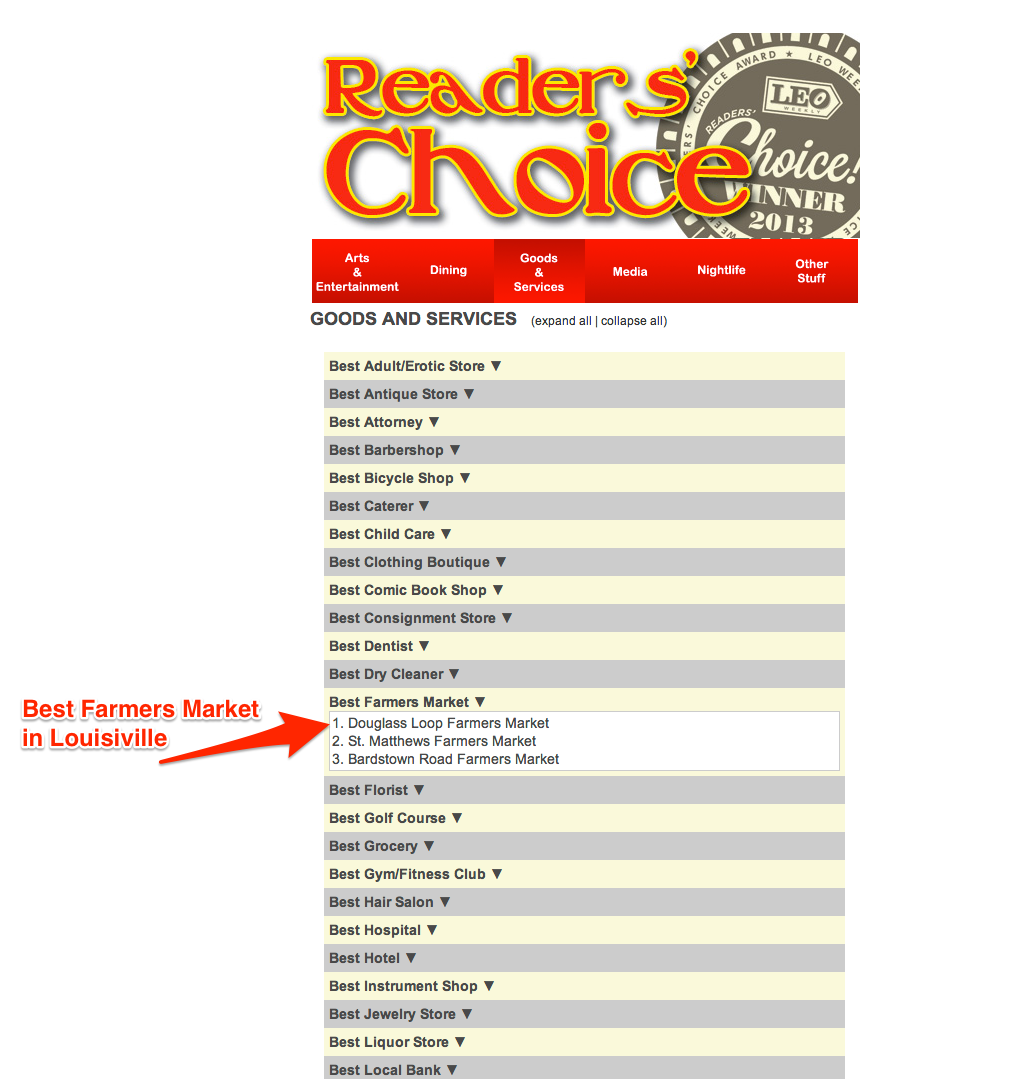
The Leo Weekly Readers' Choice Awards announces what we've all known for some time: the Douglass Loop Farmers Market (a ministry of Douglass Boulevard Christian Church) is the best farmers market in Louisville.
Thank you to The Leo and everyone who voted!

Saturday, October 26th
4-6 p.m.
at Douglass Blvd. Christian Church
2005 Douglass Blvd.
Come on out for a fun, candy-filled afternoon.

We thought the safest place to be . . . would be . . . to be . . . where we’d been . . . where we used to be.
We thought if we could just recapture what was here before, we’d be able to handle what was happening now.
The message of Jeremiah, however, is that the safest place to be is the place where God has placed us—which is to say, where God has made a place for us.
Subscribe to us on iTunes!
"As someone who loves the church, I am saddened by the perception of Christianity as a vehicle of moral control and good behavior, rather than a haven for the discouraged and dying. It is high time for the church to remind our broken and burned out world that the Gospel of Jesus Christ is a one-way declaration that because Jesus was strong for you, you’re free to be weak; because Jesus won for you, you’re free to lose; because Jesus succeeded for you, you’re free to fail."
~WILLIAM GRAHAM TULLIAN TCHIVIDJIAN
Join us for our first Sunday evening Concert in the Park. Bring a chair, cooler and your friends!
WHEN: 10/20/13
WHERE: Briney Circle
TIME: 5-7 p.m.
Sponsored by: Douglass Blvd. Christian Church


Remarks by Derek Penwell at the public dedication of Woodbourne House on September 30, 2013.
Generally speaking, when the church makes news something’s gone horribly wrong. Some group of Christians, brandishing bullhorns and grammatically dubious placards has elbowed its way into our living rooms by way of the cable news channels to inform us about what worthless reprobates we really are because we don’t believe _____ (X), or because we’re way too lenient when it comes to the issue of _____ (Y).
Then there are the scandals. We’ve witnessed too many shocking improprieties—sexual and financial—to deny it.
Christians have demonstrated an uncanny ability to avoid living up to what they say they believe. This kind of hypocrisy … of over-selling and under-delivering on our faith has rightly caused people to question our commitments.
Those folks who claim to follow Jesus need now, more than ever, to start living like he lived; which is to say, they need to start loving the people Jesus loved.
Of course, he loved everybody, but he had a special place in his heart for those living closest to the edge, those separated from the chaos of destitution by the thinnest of margins.
The author of 1 John says it well:
“How does God’s love abide in anyone who has the world’s goods and sees a brother or sister in need and yet refuses to help? Little children, let us love, not in word or speech, but in truth and action” (1 John 3:17-18).
Here at Douglass Boulevard Christian Church—beginning with the leadership of Lively Wilson—we’ve been asking ourselves over the past few years how we—who’ve been blessed with “the world’s goods”—can use what we have to offer life, and love, and justice to those whom Jesus loves. We’ve taken to viewing the resources we’ve been given as tools to be used to love people—not as artifacts to be curated in a museum.
We have this wonderful location, these beautiful buildings. Why not use them for others? Why not give them away?
I’m talking about seeing these resources as gifts that we can share with the community, not as heirlooms be covered in plastic and stored in mothballs. The buildings churches maintain are hammers—if they’re not being used to pound nails, they’re just decorations in a lovely toolshed.
And here’s the thing: If your church building is a tool, and if you spend more time polishing and oiling the stuff in your toolbox than actually making things—it is altogether appropriate for people on the outside to wonder whether you are a carpenter or merely a tool collector.
Woodbourne House is an instantiation of the belief that we’ve been given gifts—not so that we can keep them, but so that we can give them away in the service of loving those people whom Jesus loves.
Woodbourne House is our modest attempt at DBCC to extend the history and to honor the tradition of this faith community by giving to seniors in need of low cost senior housing from “the world’s goods” with which we’ve been blessed.
It is, finally, our effort to love “in truth and action,” and not just in “word or speech.”

An article about the amazing contributions of Volunteers of America, headed up by our favorite CEO, Janie Burks.

Our very own attorney of awesomeness, Ben Carter, in Business First! Click on the link to read more about Ben's decision to go into solo practice.