Douglass Blvd Christian Church

an open and affirming community of faith

n open and affirming community where faith is questioned and formed, as relationships are made and upheld. 

The Point (Luke 3:15-17, 21-22)

So, take heart, God will not be outmaneuvered; God’s purposes will not be frustrated. God is determined to establish God’s reign, a reign in which all people finally get to live in peace, in which all people get to see the arc of the moral universe finally bent all the way toward justice, in which all people are finally embraced by a love that feels like stepping through the front door at the end of a long journey home.


Subscribe to us on iTunes!

Sermon text: web | doc

The Blessed Mercy of Driving the Wrong Car

By Derek Penwell

I knew a young woman one time who, when she turned sixteen, was promised a car to drive. Needless to say, she was pretty stoked about the prospect of having her own wheels. She knew exactly what she wanted, too. This young woman wanted a new Camaro. She’d done her homework, so she knew just which option packages she wanted, all the bells and whistles. A fairly ambitious set of desires; but you’ve got to dream, right?

On the day she turned sixteen, she was ready to go with her parents down the dealership and order this fine piece of American engineering. Her dad poked his head in the door from outside and said, “Hey, sweetie! Come on out here. Mom and I have a surprise for you.”

She got up from the breakfast table and ran toward the door. She figured that this was even better than she expected. Her parents had anticipated her desires, and had gone out to surprise her by getting her the car of her dreams. Almost impossible to contain her excitement.

But as she cleared the side door and looked out in the driveway, what awaited her there wasn’t a new Camaro, but a ten year-old Pontiac Bonneville. Huge thing. It was the color of a rusted boat anchor. Looking at her “new” car, the birthday girl was crestfallen. She shot a glance at her parents. “But I wanted a Camaro,” she pouted.

Her dad said, “People in Hell want ice water. You don’t always get your first choice. This is a good car—it runs well and it’s safe.”

She broke down in tears. “Well, I’m not driving that thing around town. What will my friends think?”

And she didn’t drive it, at least for a while … until she couldn’t stand staying at home doing nothing. Then all of a sudden that Pontiac Bonneville didn’t look so bad. (Well, actually it did still look bad, but you know what I mean.)

I think about that Bonneville when I hear congregations complaining about not being who they think they should be, about not having the kind of resources to do really “important” work. You ever hear that kind of self-pity coming out of a congregation?

“We’re so small. We look at other congregations, and we’re embarrassed about what we have to offer. We don’t have a family life center. No sparkling youth program. Our ability to send our outreach dollars to the home office has been severely hampered. The whole thing is just really depressing.”

And often these congregations, because they have so little confidence, end up doing very little. Actually, let me rephrase that: These congregations end up doing very little of anything new or brave or exciting. Despairing of ever being Camaros, they’ve failed to understand that being a Pontiac Bonneville is still enough to get the job done.

What’s the job?

Of a car? To take you from point A to point B. And, given the constraints of speed limits (as well as the laws of physics), a well maintained Bonneville can do that as well as a Camaro.

What’s the job of a congregation?

To worship God and help equip followers of Jesus for the reign of God.

And here’s the thing: You can do that without a family life center, without a sparkling youth program, and without a lot of extra money.

You shame the angels if you don’t live bravely with what you have.

That’s Your Idea of a King? (Matthew 2:1-12)

Technical difficulties have made the audio unavailable today. But it's a good one, and worth reading.

derek09202015.jpg

The way our culture views it, victory means overcoming the odds and coming out on top, where the lights shine and glory fills the air. But Jesus transforms victory; he reshapes triumph. He goes up against the kingdoms of this world; but instead of battling on Herod's violent terms, Jesus prevails by refusing to become the kind of ruler his followers misguidedly want him to be—one who needs the spotlight, who craves glory—and he holds out to become the king we all need—the one who’s willing to die for a peace and justice that can never be won through conventional means—soaked to the elbows as it is in the blood of children and the humiliation of the powerless.


Sermon text: web | doc

God Among the Dispensable (Luke 1:39-55)

The Magnificat is a song that speaks of reversal. Those in the front get a divine escort to the back of the line, and those in the back finally get to sit in the owner’s box. When the Messiah comes, those who’ve gotten used to warmth and comfort are going to be forced to do some serious prioritizing, just in order to get a baloney sandwich and stay out of the cold.

See, I knew this text was going to cause trouble. And that’s just the thing. I’m a fairly normal middle-class guy; I don’t deal in Molotov cocktails or hand-grenades. I’ve got two cars and a mortgage. I don’t need this.

But I read this, and I’m not so sure Mary isn’t talking about me. Frankly, it kind of scares me to read it out loud. I’ll tell you one thing: it sure doesn’t leave me humming, 'I’m dreaming of a White Christmas,' sucking on a candy cane to get the eggnog and garlic puffs off my breath.


Subscribe to us on iTunes!

Sermon text: web | doc

How Exactly Is This Good News? (Luke 3:7-18)

How do you think the poor, the outsiders, the depressed, the bereaved, and those who’ve felt abandoned by a system that values its own interests above the interests of the helpless would hear John the Baptist? What do you think they make of John the Baptist telling the children of God to think first not about themselves, not about their pocketbooks, not about their profit margins and brokerage accounts, not about their reputations in the community, but to think first about the last, the least, the lost, and the dead?

What constitutes good news may just depend on where you’re standing when you hear it.


Subscribe to us on iTunes!

Sermon text: web | doc

A college parent (and Liberty alum) responds to Jerry Falwell Jr.’s comments on Muslims and guns - Think Christian

An interesting response Jerry Falwell Jr.'s stance on students, guns, and Islam.

Falwell, who is in a position to catechize young men and women on what the Bible says about life, death, love, hate and self-defense, instead adopted a posture best described as juvenile. Instead of taking the opportunity to lead young people through an exchange of ideas, he seemed to become one of them. The louder the students cheered, the more bravado Falwell displayed.

As a Christian, I expect more from an institution committed to following the Christ of the Bible. As a parent of college students, I would demand it.

Read the full article (via Rachel Held Evans)

The Disruption of Advent (Luke 3:1-6)

El Profeta by Pablo Gargallo

El Profeta by Pablo Gargallo

The Jesus who comes to us in Advent expects the mountains of oppression to be made low, and the valleys of depression to be filled—not just in some personal interior space where we harbor envy and bitterness and hatred, but also in the public space where 92 people die everyday from gun violence, where Syrian refugees running for their lives are met with crossed arms and closed hearts, where poor people stay up at night worrying whether the healthcare that’s saving their child’s life will be taken away by a bureaucrat in some leather covered seat of power, where young African American men die at the hands of those in control just because they happen not to have been born white.


Subscribe to us on iTunes!

Sermon text: web | doc

The Days Are Surely Coming (Jeremiah 33:14-16)

We live in ordinary time, seeing only ordinary days, but days filled with terror and avarice and hatred and despair nevertheless, days that threaten to go on and on. All we can see is the way things are presently ordered. We know how power is arranged in this world. It’s amazing what you can get used to. But the days are surely coming, says the Lord. The way the world is now is not how it must be; it’s not how it will always be.

It's Advent, that time when we peer into the distance for the one who will execute justice and righteousness in the land, who will redeem God’s children from ordinary days. We steel ourselves for the call to live as just and righteous right now, in anticipation of that day.


Subscribe to us on iTunes!

Sermon text: web | doc

Rally for justice with Mayor Fischer

In lieu of Beer with Jesus and Friends tonight, we're going to be going downtown to stand with Mayor Fischer and other Louisvillians in a rally of solidarity.

Mayor Greg Fischer is calling on residents to join a community rally Tuesday to show Louisville's solidarity with victims of recent terrorist attacks while welcoming immigrants fleeing those same extremist groups.

The mayor is lending his voice to the event in the wake of Congress' bipartisan vote last week to halt the resettlement of refugees from Syria and Iraq to the U.S. amid growing security concerns about the immigration vetting process.

This is really important.

6 p.m. Jefferson Square Park. We'll see you there.

The Question Isn't "Where?" but "What?" (John 18-33-37)

But Jesus doesn’t deal with others first as threats to be feared; he embraces them as sisters and brothers created and loved by God, and therefore, deserving of our profoundest attempts at love and welcome.

So, when Jesus says his 'kingdom is not from this world,' he ain’t kidding. The kind of realm over which Jesus reigns appears unintelligible to a world that believes threats are to be eliminated (by violence if necessary). Any kingdom that takes as its guiding principle the need to 'love your enemies and pray for those who persecute you' is bound to appear alien to our current world.


Subscribe to us on iTunes!

Sermon text: web | doc

How you can help refugees

A refugee crisis is defined by helplessness. Helplessness of those fleeing their homes, families, and lives; helplessness of aid workers to feed and shelter them; helplessness of governments to stop the violence; helplessness of those living in safe lands to provide those in crisis safe passage and a new home; it lingers like a fog.

Our helplessness as people of faith can cause us to lash out, decrying those who speak and act from fear rather than compassion. But we are not entirely without agency, and there are productive ways to help. We can reroute that energy into programs dedicated to helping refugees and immigrants find food, shelter, and the tools they need to rebuild their lives here in Kentucky.

Americana Community Center

Americana Community Center is a non-profit organization which provides a spectrum of services for the many diverse residents of Louisville Metro. These services enable people to discover and utilize resources to build strong families, create a safe, supportive community and realize their individual potential.

If you have anything else you'd like to offer, you can contact Clare Rutz for more info.

Kentucky Refugee Ministries

Kentucky Refugee Ministries, Inc. (KRM), a non-profit organization, is dedicated to providing resettlement services to refugees through faith- and agency-based co-sponsorship in order to promote self-sufficiency and successful integration into our community. KRM is committed to offering access to community resources and opportunities and to promoting awareness of diversity for the benefit of the whole community.

Catholic Charities: Migration & Refugee Services

The mission of Migration & Refugee Services (MRS) is to provide refugees with the support and assistance they need in order to become self-sufficient. The role of Migration & Refugee Services is to involve, organize, and bring together the agency, church, and community resources necessary for successful resettlement.

Or, of course, you can give to our general fund here at DBCC, which has been used to support many organizations seeking justice for the disenfranchised.

The best way to help those in need is to support the people and organizations who are committed to doing so. Let's share our wealth and help them make a difference.

If anyone has organizations or people to add to this list, please email Geoff, who will work to get them up quickly.

Rumor Has It (Mark 13:1-8)

Brian Cubbage in the pulpit today. Always excellent.

Jesus reminds us in today’s text that we are not the walls we build. We are not the edifices we inhabit. There is life after stone tumbles upon stone. The birth pangs he identifies are not, or not just, for a new order of things, yet another set of walls, yet another house in which we try to trap God and, in the end, only trap ourselves. The birth pangs are ours: for the new selves that God seeks to birth in us; for the new creations God seeks to make of us.


Subscribe to us on iTunes!

Sermon text: web | doc

More Than All Those (Mark 12:38-44)

What if the point Jesus is making isn’t: Be more like the widow?

What if the point he’s making is: Don’t prop up systems that hungrily seek the last pennies of those who can afford it least?

Apologies for missing the recording of the scripture, which is sort of important. You can read it here.


Subscribe to us on iTunes!

Sermon text: web | doc

A Letter to My Youngest upon Wandering through a Graveyard

By Derek Penwell

Dear Dominic,

I want to tell you about a graveyard I wandered through today. It was rainy and chilly, which seems appropriate if you're going to wander through a place where dead people make their home.

A dry-stone wall rings this patch of land. The stones, which have soft moss colonizing an inhospitable world, are stacked in a way that first appears haphazard, but in reality has its own sense of order and purpose. I suspect that each of those stones has a story to tell about the world that formed them and the hands that laid them.

I'd like you to see what I see and hear what I hear as I wander. The train offers up a plaintive sigh in the distance, while birds perched on a broken branch occasionally provide their own commentary on the landscape we behold.

As you walk down the rows, between the gravestones, you can smell the musky scent of the creek that lies just beyond the far wall. You may also notice that a great deal of time seems telescoped into a very small space, neighbors from different centuries tend their sad homes side by side in this humble stretch of ground.

You may also notice that old people and young people reside next to one another, making their ages unimportant in ways apparently impossible for those of us who tread new paths on top of these old dwellings. But the gravestones, rather than a barrier, form a community whose requirements for membership do not extend to such unspeakably insignificant things as age (or race, or gender, or class, or religion, or sexual orientation, for that matter).

The whisper of the creek carries the muted voices of this particular neighborhood, muted voices anxious to tell a thousand different stories–stories that even the wise stones are not articulate enough to tell.

You cannot quite make out the details of the stories in the language the creek speaks, but you can imagine the tales the whisper wants to tell. And as the creek continues to unfold its watery narrative, you may begin to notice that the stories themselves are alive, that each piece of limestone that stands in the water's way, rather than prevent them, allows the stories to be told again and again–an eternal record of the community gathered.

You may sense the spirit of those buried joining together, an expectant company of those departed but still strangely present, hoping desperately for someone to stop and listen to lives that we often think have slipped quietly into the darkness, but lives that continue to speak nevertheless–even though it's true that most times the only ones there to hear already abide in this sacred community, among the broken stones that surround them and the rippling stream that gives voice to their longing.

I want you to wander through this graveyard with me, my son, so that you may recognize the muted voices of our own lives, which will one day also join this commonwealth and be borne upon the song of the waters. A strange joy to be welcomed home.

Love,

Dad

Where God Is (Revelation 21:1-6)

Our passage this morning about the new Jerusalem doesn't say that God's home is among mortals . . . except for, you know, the Muslims, or the atheists, or the Republicans (or Democrats, depending on your politics). God doesn't say, 'This place would be just perfect if we could get rid of the people who live on the other side of town, if we could just check papers for the undocumented, or the hoodlums, or the St. Louis Cardinals.' God says, 'Ok, so it's a fixer-upper. I'll take it. I'm going to do a little renovation anyway, but the neighborhood is just exactly my kind of people.'


Subscribe to us on iTunes!

Sermon text: web | doc

2015 Halloween Party

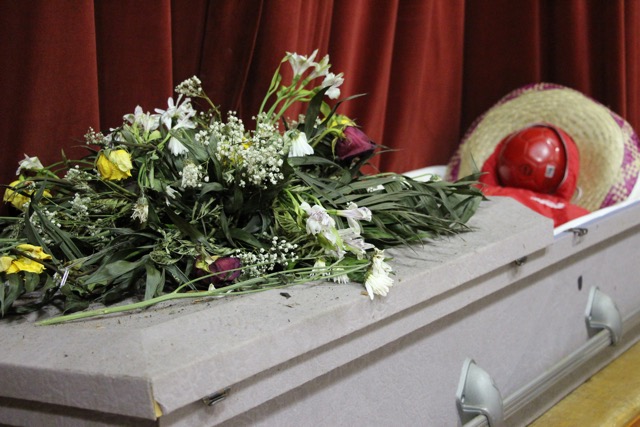
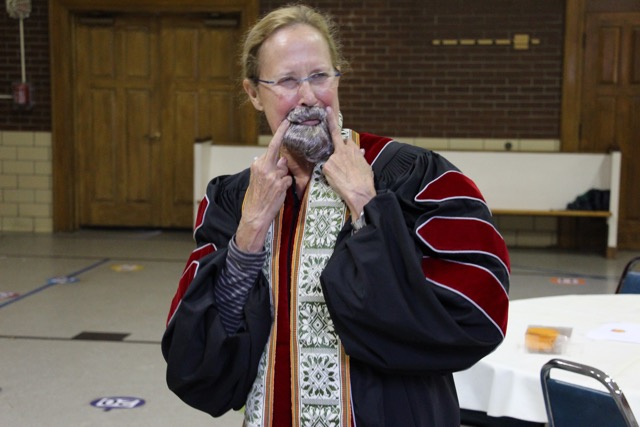
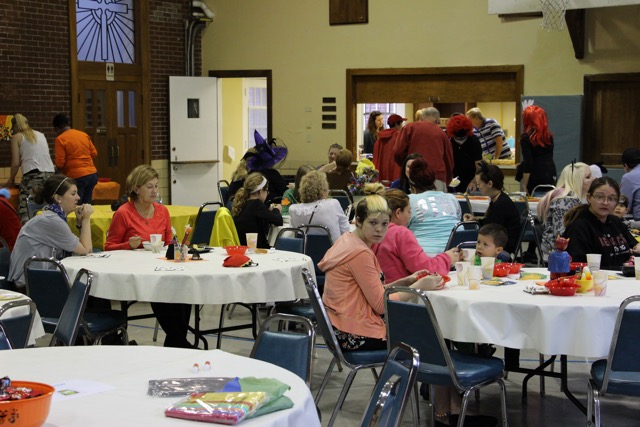
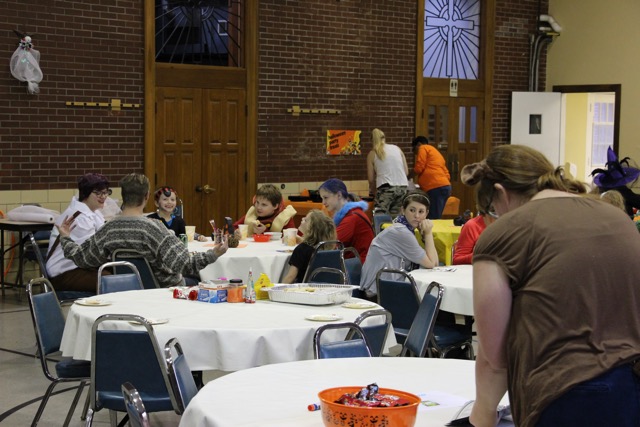
We had a great time at the Halloween party Saturday night! It was wonderful to have the women and children from Freedom House with us. Thanks to everyone who participated, and everyone who helped. Most of all, thanks goes to Jennifer Vandiver for organizing everything.

What Do You Want Me to Do for You? (Mark 10:46-52)

derek09202015.jpg

So when Jesus asks, 'What do you want me to do for you?' we believe we know how to respond. 'This or that,' we think, is what will enable us better to follow Jesus 'on the way.' A little tuck here, a pinch off there, and we’ll be good as new. We don’t need much. Already in pretty good shape.

But what if Jesus’ vision of what we need is different? What if Jesus sees a completely different road from the one we’ve been trained to expect? What if following Jesus is being given eyes to see that what formerly looked like failure is precisely the path down which we’ve been called?


Subscribe to us on iTunes!

Sermon text: web | doc

In Your Glory (Mark 10:35-45)

derek09202015.jpg

Popular Christianity promises a Jesus who only wants to be your pal, a Jesus who doesn’t want you to be inconvenienced, a Jesus whose real concern is that all your biases are continually reconfirmed for you. A Jesus who knows what true glory looks like. And, let me tell you, that would be a whole lot easier on me.

But unfortunately, I’m not good enough at this to give you that Jesus. Instead, I’m so incompetent at my job that all I can manage to figure out how to give you is a Jesus who seeks out the small, the irrelevant, and the marginal. I’m only skilled enough to show up on Sunday mornings with a Jesus who thinks glory looks like losing, sacrificing, and dying. I hope you’ll forgive me my vocational inadequacies.


Subscribe to us on iTunes!

Sermon text: web | doc