Call to the Host (er . . . Post)
In honor of Kentucky's grand tradition, DBCC offers a call to the Post!
(Mint Juleps will be served in the Narthex.)

an open and affirming community of faith
n open and affirming community where faith is questioned and formed, as relationships are made and upheld.
In honor of Kentucky's grand tradition, DBCC offers a call to the Post!
(Mint Juleps will be served in the Narthex.)
"No, you start telling people that they live in a place where they can see the face of God, and pretty soon they’re going to start living like it’s true.
"And it’s not even like we’re responsible for pulling it off, for planning this new world that looks like John’s picture of God’s new city. But one day, after spending all this time with a different vision, we wake up to see that we inhabit an entirely different world from the one we used to inhabit, or the one that used to inhabit us."
A sermon on Revelation and the New Jerusalem.
Subscribe to us on iTunes!

FOR IMMEDIATE RELEASE
Tuesday, April 23, 2013
CONTACT:
Chris Hartman, Fairness Campaign Director
(502) 640-1095; @FairnessCamp
Dr. Noell Rowan, BSW Program Director, UofL Kent School of Social Work
(502) 852-1964; NLRowa01@louisville.edu
"Aging Fairly" Series Includes FIlm & Lecture on LGBT Elder Issues
April 28, 4 p.m., UofL Chao Auditorium; June 9, 5 p.m., Douglass Blvd. Christian Church
(Louisville, KY) As part of its "Aging Fairly" series, the Fairness Campaign is partnering with KIPDA Mental Health and Aging Coalition, the University of Louisville Kent School of Social Work, The LGBT Center at University of Louisville, Mad Stu Media, Faith Leaders for Fairness, and True Colors Ministry to present showings of Stu Maddux's award-winning documentary film on LGBT aging, Gen Silent.
Each film showing is coupled with a brief lecture by Dr. Noell Rowan, BSW Program Director of UofL's Kent School of Social Work, who will reveal findings from a groundbreaking Hartford Faculty Scholars research project, Resiliency and Quality of Life for Older Lesbian Adults with Alcoholism. The series is free to the public with refreshments and will be shown Sunday, April 28, 4:00 p.m. at UofL's Chao Auditorium in the basement of Ekstrom Library and Sunday, June 9, 5:00 p.m. at Douglass Boulevard Christian Church, 2005 Douglass Boulevard.
The film showing and lecture series is part of the Fairness Campaign's ongoing efforts to promote awareness in the community of LGBT aging issues and disparities among older LGBT adults. As chronicled in Gen Silent, many older LGBT people struggle with going back into the closet as they fear prejudice and unfair treatment in assisted living facilities and nursing homes. According to Improving the Lives of LGBT Older Adults, a joint study by the MAP Project, Center for American Progress, and SAGE, 8.3% of LGBT elders reported abuse or neglect by a caretaker due to their sexual orientation or gender identity, senior lesbian couples have almost twice the poverty rate of senior heterosexual couples, LGB older adults have 11% higher alcohol abuse rates than their heterosexual peers, and 72% of LGBT seniors are hesitant to engage in mainstream aging programs for fear of being unwelcome, among other staggering statistics.
"With more than 1.5 million LGBT seniors living in America today, and with that number ever increasing as more Baby Boomers join those ranks, caring for and better accommodating the needs of our LGBT elders has become an increasingly urgent issue on the Fairness Campaign's radar," shared director Chris Hartman. "In the coming years, we will be deepening our partnerships with these and other organizations--like Elderserve, Inc.--to best serve Louisville and Kentucky's LGBT seniors."
WHAT: "Aging Fairly" film and lecture series
WHEN & WHERE:
Sunday, April 28, 4:00 p.m.
UofL's Chao Auditorium in the basement of Ekstrom Library
Sunday, June 9, 5:00 p.m.
Douglass Boulevard Christian Church, 2005 Douglass Boulevard
WHO: Dr. Noell Rowan
KIPDA Mental Health and Aging Coalition
University of Louisville Kent School of Social Work
The LGBT Center at University of Louisville
Fairness Campaign
Mad Stu Media
Faith Leaders for Fairness
True Colors Ministry
By Derek Penwell
I had a parishioner write something the other day that I can’t quite get out of my head. Darla is an advocate in the state capitol on behalf of the rights of the disabled and the elderly, and had a bill go on life support -- the Adult Abuse Prevention Bill. (How do you not support that?)
In her disappointment, she wrote: “I sit here again thinking about exactly where do I want to be when justice does roll down!”
I’ll be honest: That question haunts me. Darla was referring to the famous passage from the prophet Amos, who , in a time where grave disparities existed between those in power and those on the margins, between those dining on bone china and those forced to eat leftovers out back from the dumpster, wrote:
“But let justice roll down like waters, and righteousness like an everflowing stream” (5:24).
Apparently, God has become upset with Israel because of the way those in power have treated the folks at the bottom of the food chain. God’s anger stems from the fact that “they sell the righteous for silver, and the needy for a pair of sandals -- they … trample the head of the poor into the dust of the earth, and push the afflicted out of the way” (2:6b-7a).
The irony in Amos, however, is that the people who oversee this oppression labor under the assumption that they’re on God’s side. The oppressors are God’s people, people who long for the “day of the Lord.” They believe that when God sets things right, they’ll be -- as they’ve always been -- on the winning side of things.
But God says something like, “Don’t be so quick to hunger for the day of the Lord. The justice you seek may not be nearly as pleasant for you as you imagine” (5:18).
In other words, the people God is most annoyed with are the people who’ve always considered themselves the heroes of the story, the ones whom God should be grateful to have on the team -- the ones who throw holy festivals, who gather in solemn assemblies, who offer up all the right sacrifices, who sing beautiful songs -- all to God. These are the people who’ve taken care to make sure they believe all the right things, who hold all the correct theological positions and whose liturgical prowess is unmatched.
What is God’s response to these pillars of the assembly?
“I don’t care about your spiritual virtuosity! Fine, you know your way around the scriptures. You know what fraction of an ephah of flour should be used to bake bread for the tabernacle. Congratulations! You have an exhaustive metric concerned with determining who’s fit to bother with, and who doesn’t measure up. Here’s the problem, though: none of that means anything, since you forgot that all that stuff is a tool to make you into the kind of people who seek justice by loving the people I love.”
When my daughter was about 4 years old, she’d just received (at our prompting, of course) the latest in what must have felt like an endless string of apologies from her older brother for hitting her.
“Tell your sister you’re sorry,” we said.
“I’m sorry,” he mumbled.
And she said something that still calls out to me: “I don’t want your ‘sorries.’ I just want you to stop hitting me.”
You see, the thing is: It’s easy to do that which seems big and true and righteous, but costs me little. Doing something that costs me, really costs me, is difficult. And I’m not talking about money, except inasmuch as money stands as another way to control the world I live in.
Making myself vulnerable. Voluntarily surrendering power. Placing myself in someone else’s hands. Not getting to be the boss of who’s in and who’s out, who’s worth helping and who “should have known better in the first place.” These things cost me.
Being right isn’t a bad thing. I try to do it regularly myself. But when being right costs you nothing and someone else everything, Amos says you’re bound to get crossways with God -- since God seeks first to love us, and through us to love one another. Even God is less interested in being right than in being loving -- for Christians, that’s what that whole Jesus thing was about.
God says to the keepers of the keys: “For my part, give me justice. Justice. Let it roll down like waters, and righteousness like an everflowing stream.”
And for God, justice doesn’t mean simple fairness, flattening everything out so it’s the same. Justice means seeking for everyone what they need to flourish.
So, where do I want to be when justice rolls down? My first inclination is to say: “I want to be on the right side of it.”
If I read Amos anything like correctly, my heart says: “When justice rolls down, I want to be right in the middle of it.”
"The story of Peter and Cornelius is a tough passage just to the extent that it asks us to do the difficult work of continuously discerning the movement of the Holy Spirit. Where is God going? What kind of new thing is God up to? Who is it that makes us uncomfortable, whom God is busy trying to welcome into the fold?
"It’s a lot easier to sit back, point out the rules, and say, 'This is the way God’s always done it before.' But God is bigger than our attempts to box God in. God cares about establishing a a reign of justice and mercy, not about making us feel comfortable."
Subscribe to us on iTunes!
April 24, 2013 / DBCC / Source

With the rise of both the "nones" and immigrant faith groups, the way future of faith seems squeezed between two opposing forces. What is the way forward? How about this?
"What if the path toward awakening is simple? Embracing faith as if we really mean it, not worrying about institutional power or rich congregations, living out the teachings of Moses and Jesus, sharing with others, seeking to be at peace with all, loving our neighbors as ourselves?"
A thought provoking article by Diana Butler Bass. Take some time to read it.

So how can we hear what he has to say? How can those who earnestly seek to be his sheep know what his voice sounds like?
You want to hear Jesus? His voice sounds like a hungry child being fed.
You want to hear Jesus? His voice sounds like an undocumented worker being treated like a human being—with kindness and dignity.
You want to hear Jesus? His voice sounds like the hand of an old woman being held as she struggles to take her final breaths.
You want to hear Jesus? His voice sounds like a gay teenager being treated like a normal kid in a world intent on treating him like he’s got something wrong with him.
You want to hear Jesus? His voice sounds like a poor mother finding medicine for her sick children.
You want to hear Jesus? His voice sounds like an eight year-old boy holding a sign that says, “No more hurting people. Peace.”
Subscribe to us on iTunes!
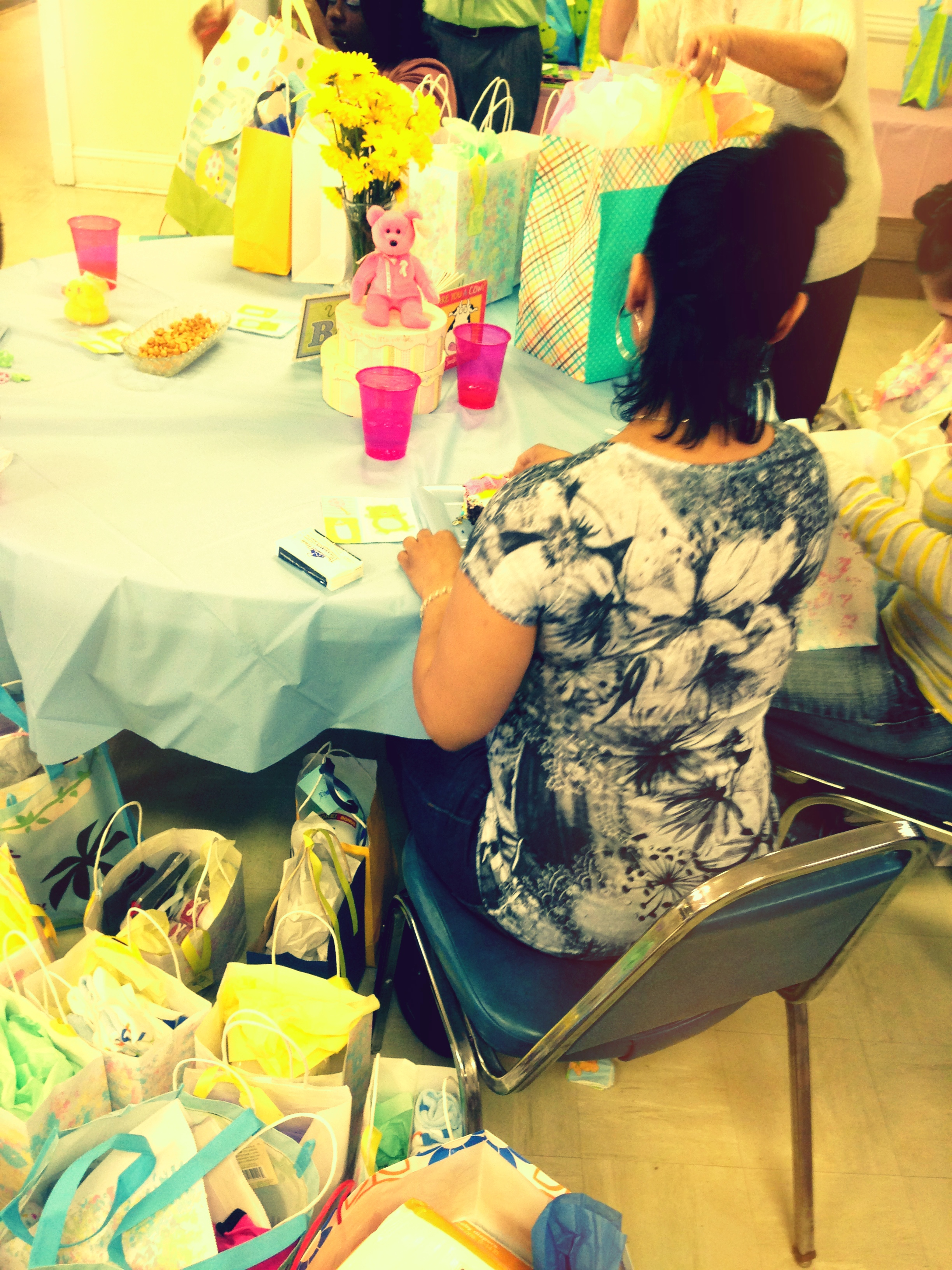
This afternoon (Sunday, April 21) members from DBCC gathered together to throw a baby shower for the women of Freedom House, a drug treatment program for women and their children, run by Volunteers of America. Church members bought shower presents for eight women, as well as larger gifts to be distributed by Freedom House.
Good times? Only if you like cake, presents, and love!


"So, we treasure the wonderful feeling of forgiveness, of having people love us more than they hate our mistakes.
"And if that were the end of the story, we could walk away feeling loved, relieved that the break between us no longer defines our relationship to one another.
"But Jesus doesn’t just forgive Peter; he does something even more amazing.
"He restores Peter’s vocation, gives him a job: “Feed my lambs.'"
Subscribe to us on iTunes!
April 09, 2013 / DBCC / Source
Do you hear that? It's the winds of change
"Or is what’s at stake here something different? Perhaps the call here has to do with figuring out a way for Jesus’ followers to proclaim the truth of the Gospel in a public way that actually communicates something positive about the unfolding reign of God—in which the poor receive good news, the captives are released, the blind are given sight, and the oppressed are set free."
Subscribe to us on iTunes!

By Derek Penwell
Shipping. In the end it’s all about shipping.
It’s not about starting. Anyone can start.
It’s about producing. It’s about seeing a project through to completion. It’s about shipping.
Used to be, I was a good starter. I liked the process. I’d get excited about something, and I’d go out and buy a notebook to start taking notes, start planning, start getting ready to start.
And pens. I bought a lot of pens.
And calendars. Notebooks, and pens, and calendars.
How could I not be serious with all these office supplies?
Or, after I got into the computer age, it was software. If I only had the right software, I’d already be finished.
The problem was I mistook starting for shipping. I thought that if I could just get started, I would have done the really important work. If I could just line up the perfect office supplies, the right software, I would have solved the hardest part.
I mistook preparing to work for work.
And it’s not that preparing for work is unimportant. You need the right tools to do the job. Unfortunately, I spent so much time getting the right tools, then organizing them, and making sure the desk or the paints or the tool bench was just so, that I could walk away from the work thinking I’d accomplished work without ever actually working.
Perhaps, even more importantly, I usually had tools enough to start anyway. I convinced myself that the work couldn’t get done, however, without “better” tools.
Here’s what it took me so long to figure out—and occasionally still need help figuring out—good work is the application of resources in the service of realizing a goal—that is, good work is about completing a project and shipping it. Good work doesn’t require a perfect beginning. Perfect beginnings are a white whale that lead you to the middle of nowhere.
Good rule of thumb: If the work you’re doing isn’t bringing you closer to achieving your objective, it’s wasting your time. Not only is it not helping you do good work, it’s preventing you from doing good work—since all the fiddling around deceives you into thinking you’re actually doing something, when in fact, you’re actively, not doing the very thing that would help you achieve your goal.
Sometimes you just have to use the notebook you have.
Maybe you have to make peace with the fact that the old Bic you find at the bottom of the drawer will work just fine.
Perhaps what you need isn’t new software, but a bare-bones text editor and the determination to start driving the cursor across the page—before you have all the details worked out.
One of the problems with following Jesus is that you never know quite where he’s going to go. According to the Gospels, the disciples regularly found this little idiosyncrasy of Jesus vexing.
First, he’s going here. Then, he’s going there. The disciples found it next to impossible to keep up with him.
Then, after Jesus left, they stood around, waiting for someone to tell them what to do next.
After the ascension, they stood around looking into the heavens, wondering, “Now what?” Suddenly, two men in white robes sidle up and say, “Why are you just standing there? Quit mouth-breathing and get back to work.”
At Pentecost, they were all gathered together in the Azalea Room at the local Holiday Inn Express, wringing their hands, unable to work out just where to go next. The Holy Spirit showed up, kicked them out into the street with no discernible plan, “For crying out loud! Will you just get out there and start working?”
“We don’t know what to do.”
“Of course you don’t. And you’re never going to know sitting here, rearranging office supplies. You’re going to have to get out there and start.”
“We don’t know where to go.”
“If you wait to start walking until it’s all lined up for you, you’ll never find out where you need to go.”
“But what if we go in the wrong direction? What if we do the wrong thing?”
“You will. Inevitably. You’re going to make so many mistakes, even Lindsay Lohan’s going to look thoughtful next to you. But so what? Most likely, you won’t know exactly what to do and where to go until you’re already out there in the middle of it. So, go ahead and make some mistakes; because making mistakes in the service of a goal is preferable to sitting about endlessly rehearsing the reasons to continue sitting about.”
Congregations too often gets sidetracked. Worried about making mistakes, congregations freeze up.
Well, that’s not true entirely. It’s not like congregations that are afraid of making mistakes don’t do anything. They start things; they just don’t ship much that’s interesting. Unfortunately, the things they start are things with which they feel comfortable.
They spend a great deal of time lining up budgets, making flow charts, buying fancy stationary, dreaming up new programs. And these things feel like good work, like ministry.
But so often these scared congregations stop just short of doing good work because they fear making a mistake. Not wanting to do something that might raise the ire of the faithful, they stick to things they know—which would be one thing, if what they know actually took them toward anywhere interesting. As it is, much of the normal flurry of activity fails to help them arrive at a destination, amounting to energy expended in the service of wheel-spinning.

"Even she, who’d hung on every word he’d said while he was still alive, didn’t recognize his voice for Death whispering in her ears. But then Jesus said her name. And when Jesus calls your name, no power on heaven or earth is strong enough to silence his voice."
Easter is here! Time to live the resurrection!
Subscribe to us on iTunes!

Finally (no thanks to Geoff), our new Director of Music is officially on the staff page. Check him out. Show him some love.

If you're in question of the timbre of [D]mergent, their new foray into branding may set you straight.


YES. They most certainly are sleeveless.
Ya know. Just so you don't have to cut the sleeves off yourself - something we were all going to do anyway.
If you're interested in buying one (of course you're interested), they're available on Cafe Press.

"Ambivalence is often the place where we live. Things are generally never all good or all bad. Whether it’s the glory of palms or the passion of crucifixion, the good news of the gospel is … God won’t rest until Easter outshines them all."
Palm/Passion Sunday, folks. Heavy stuff. As we all know, Good Friday is just a few days away.
Subscribe to us on iTunes!
March 20, 2013 / DBCC / Source
What If the Kids Don't Want Our Church?
A word to the wise, Congregations at large. Don't become this guy.
"Hey, you kids get off of my Antique American Oak Bow Glass China Cabinet!"
Arguably, one of the Rev's best yet.
A poem from our own Darla Bailey. A variation on it was used in this week's greeting.
    God, I have seen you hungry –
But, Lord, I have never been without food;
   and yet, I have ached from within for the answers to the
  questions that go unanswered, I have ached for serenity,
  courage and wisdom.

      God, I have seen you thirsty –
But, Lord, I have never been without water;
    and yet, I have wanted to quench my yearning for rest
    and refreshing news of guaranteed peace for the future.

     God, I have seen you naked –
But, Lord, I have never been without clothes to cover my body;
    and yet, I have felt vulnerable and exposed.  I have wanted to wrap up
    in a garment of comfort and compassion.

     God, I have seen you in prison –
But Lord, I have never spent even a day behind bars;
   and yet, I have yearned for freedom to express myself as
   I am.  To  be able to break from the shackles and demands and pressures.

     God, I have seen you as you have been
   hungry, thirsty, homeless and imprisoned.
And, yes, Lord, I have seen my own self – my own needs.  May I
    see you as my fellow sojourner – traveling the journey of
    faith along side me.

Darla A Bailey 3/1990

This past Sunday, we were blessed to have Diana Garland deliver our sermon. Came all the way from Waco, TX. She proceeded to blow our minds.
“Christianity is not about what we believe. The way to love God is to love those whom God loves.” —Overheard at @douglassblvdcc
— Ben Carter (@notbencarter) March 17, 2013