Fear and Welcome (Mark 9:30-37)
Welcoming the wonderful (and newly ordained) Rev. Nicole Hardin to the pulpit.
Subscribe to us on iTunes!

an open and affirming community of faith
n open and affirming community where faith is questioned and formed, as relationships are made and upheld.

Welcoming the wonderful (and newly ordained) Rev. Nicole Hardin to the pulpit.
Subscribe to us on iTunes!

What if the cross, as fearsome and terrifying as it is,is the place where we meet Jesus?
What if the cross allows us to consider that cross-carrying is not an individual, but a team sport? Even Jesus needed help lugging that lumber up the road. Not only do we find Jesus struggling under the load, but we find one another there too.
Moreover, being near Jesus puts us near the poor, the disenfranchised, the powerless. That’s good news. Because since we’ve embraced the cross, we’ve already embraced powerlessness, not as a strategy for effective living but as a way of life that seeks above all else to follow Jesus wherever he goes.

Abiding, which on the surface feels so passive, is just the opposite. If we abide in Jesus, if we live out the vision of the world he sees, we can’t help but take on the work of dismantling the systems that result in the shedding of the lifeblood of the poor and the outcry of the oppressed. We have no choice but to stand against the powers that foreclose on the futures of the defenseless, in the service of adding to the stockpiles of their own avarice.
Abiding, at least as Jesus imagines it, is the greatest act of communal resistance there is.

When Paul says that our struggle isn’t against enemies of flesh and blood, but agains the cosmic powers of this present darkness, against the spiritual forces of evil in the heavenly places—he’s not talking about some other worldly weirdness. The cosmic powers of this present darkness, the spiritual forces of evil in the heavenly places aren’t some kind of super demon army, some version of Indiana Jones and the Flaming Arrows of the Evil one.
And he’s not talking about our personal demons for which we need a mystical Batmobile and sanctified kevlar. He"s talking about the powers and principalities that institutionalize injustice and subjugation right here, right now.
The kind of powers and principalities that let LGBTQ people die alone with no one to speak their name, the kind of spiritual forces of evil that have systematically terrorized African Americans for four hundred years, the cosmic powers of this present darkness that lock immigrant children not in spiritual prisons tended by celestial guards, but in actual cages tended by agents of Caesar.

We’re conditioned, socialized to the see the world through lenses that magnify everything. Ministers often keep score the way everyone else does.
What we rarely stop to ask ourselves is whether, in all our scorekeeping and advanced measure-taking, we’re keeping score of the right things, measuring the stuff that really matters.


Eternity can, of course, mean in the great forever in the future—some endless span of time. But eternity doesn’t just have to be about the length of time; it can signify the depth of time, which is to say the quality of time. In that sense, then, food that endures for eternal life can be about food that deepens the quality of time right here and now by having enough, so that people no longer need to follow a potential messiah around the wilderness in constant search for a little relief from the hunger that besets them—so that eternity can begin to break into the world right now.
Notice that Jesus doesn’t talk about bread that lasts forever; he offers bread that endures for eternal life.

By Derek Penwell
For the Lord your God is God of gods and Lord of lords, the great God, mighty and awesome, who is not partial and takes no bribe, who executes justice for the orphan and the widow, and who loves the strangers, providing them with food and clothing. You shall also love the stranger, for you were strangers in the land of Egypt (Deuteronomy 10:17-19).
We all take things for granted. Navigating our world day-to-day requires a certain amount of taken-for-grantedness. I take for granted that when I give the cashier a little blue piece of plastic that I’ll be able to take my lima beans and Wonderbread and walk out of the Kroger unmolested.
I take for granted that when I go to Pizza Hut they’re not leavening the dough with Drano.
I take for granted that when this rally is over, I’ll get in my car to go home, and everyone else on the road will know to drive on the righthand side of the road.
Indeed, I take for granted that after this is over, I’ll have a home to go home to.
Most of us take for granted that home is a fixed place that’ll be there whenever we need it.
But not everybody in the world has a place they can call home. Because, I suspect, we all realize that home is more than an address with a few shrubs, a mailbox, and a toxic waste dump for your neighbor’s 200 lb. Mastiff.
There are some people who feel like the place they were born and learned to call home is no longer safe enough to be anything like a home. And so they pack up their children and they come here in the hopes of finding a new home and new neighbors—and if not a home then at least a place that will protect their children from the violence and death they’ve grown to expect in the places they come from.
But now?
What happens now with the “zero tolerance” policy is that families in search of a home are torn apart. This administration has decided that children are an acceptable price to pay to keep people of color from “invading” our country.
This administration has made the strategic calculation that it’s altogether acceptable to say to the parents of these children, as well as to intransigent bleeding heart liberals and progressives: “That’s a nice baby you’ve got there. It’d be a shame for something to happen to her.”
In just 6 weeks, thousands of children have been ripped from their parents’ arms. Doctors tell us this kind of trauma causes lifelong mental, emotional, and physical harm. And there’s still no plan to reunite these families, to restore to terrified parents and children the possibility of ever again finding a home together. The closest thing the folks in charge have got is locking up families in the same facility.
But that’s not putting families back together; it’s just crushing them in a new, more deniably evil way.
You see, home is where people welcome you . . . often when you’ve got no place else to go. In the world of the Bible not to have a home was to be vulnerable to violence and exploitation. Those who were most vulnerable because they often had no home were widows, orphans, and strangers.
In fact, more than any other commandment in the Hebrew Scriptures, the exhortation to care for widows, orphans, and strangers is more prominent than any other commandment . . . over three dozen times it’s in there. You can find it in the Law, in the Psalms, and in the Prophets.
God holds a special place in God’s heart for those who can’t find welcome in this world, a home for those whose homes can no longer welcome them. A place to belong, a place where hospitality is extended.
As a person of faith, I have a vested interest in the issue of hospitality, of extending the hand of welcome.
In our culture, we tend to believe that hospitality has to do with things like potato salad and chicken casserole. But when people of faith talk about about hospitality, we’ve got our sights set on bigger things. Because cultivating hospitality is about having a disposition, an attitude of openness, which asks first about how to serve and embrace others—regardless of what the folks in charge think about it.
And if I’m being honest, I’m baffled by white evangelicals who think this president is a champion for Christian values. He hasn’t done anything that if the Jesus they claim to follow showed up on the scene would cause him to say, “Yeah, nice job! That’s totally what I had in mind.”
People of faith have got to do better—Hindus, Buddhists, Jews, Muslims, Christians. All of us, people of faith and people of no particular faith . . . we bear responsibility for the treatment of widows, orphans, and strangers. And we can’t sit idly by while innocent people, people just searching for a home under the banner of our protection are thrown in cages.
We’ve got to join our voices together to tell the government “No! You’re not going to continue to commit atrocities against people of color in our name—just to score political points with racists and white nationalists! We will not allow it!”
Because don’t kid yourself, you start welcoming the stranger to make a home among us, speaking up on behalf of the undocumented and those fleeing violence, you start advocating for sanctuary for those oppressed by the government . . . you’re going to make the big shots in Frankfort and Washington nervous.
But maybe what we need most right now is some nervous politicians, politicians scared of our outrage, afraid of what we’re capable of doing in the name of justice and love.
When we talk about welcome, about hospitality, we’re not concerned with drawing boundary lines to indicate just who deserves it; we’re interested in blowing open the doors and welcoming everybody in. To the people usually on the outside of polite society with their noses pressed up against the glass wishing someone would welcome them—we say, "Let 'em all in. Don't cross-reference the guest list; don't check I.D.s at the door, don't ask for the password and the secret handshake, don’t make sure they’re the right color. Look them in the eyes, embrace them, and say, ‘Welcome home.’”
Because the real question to those of us who care about our neighbors is:
Are we willing to love the wrong people hard enough to make the folks in charge nervous?

Jesus in this meal isn’t just—as Pastor Bob says— 'staying out of politics and unconditionally loving, comforting & healing all the hurt and damaged people.' In feeding the 5,000 Jesus disrupts one of the political and economic tools the powerful use to keep the peasants in their place—hunger and scarcity. And in so doing, Jesus offers up a political challenge to the ruling authorities.
That’s why Jesus was always getting sideways with the Romans. His ministry was by its very nature a threat to the political and economic status quo. In other words, in accounting for his conflict with and eventual execution by the Roman state, we have to come up with a picture of Jesus as something other than a nice guy dispensing Deepak Chopra-nuggets of wisdom. If that’s all he were, the Romans would have loved him. It’s because they understood the political implications of his teaching that they killed Jesus.

On Easter God said 'no' to the death-dealing powers that divide us on the basis of money, power, gender, sexual orientation, gender identity, and immigration status. Indeed part of the reason Jesus was killed was because he announced a new world breaking in, a completely different kind of politics that has as its primary focus the destruction of the walls that divide us—since the powers that be always have the most to gain by keeping people divided, and therefore, powerless.

Rev. Mary Ann Lewis in the pulpit today!
Subscribe to us on iTunes!
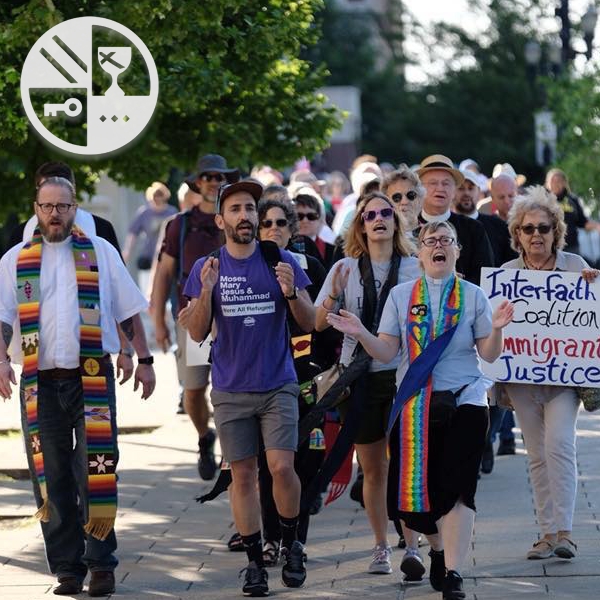
Of course, the church seeks to meet people’s needs. But one of the most pressing needs people have is to see a vision of the world the way God envisions it—a world in which sick people, and poor people, and hungry people, and disabled people, and immigrants, and LGBTQ people, and marginalized people not only have a seat around God’s table . . . but have been made the guests of honor.
We ought to spend more energy worrying about how the church should form its community and its members as stirrers of the waters, as a sanctuary for compassion, as healers of brokenness and isolation, as lovers of all people, as Dr. Martin Luther King called us, members of the 'creatively maladjusted.'

When Jesus walks the margins looking for those who creep around the edges, he redefines the edges, so that the margins are set in the center; and it's the folks who usually occupy the center who risk finding themselves on the margins. When Jesus starts looking for people to love, he first starts with those who have for too long been hiding in the shadows.

Hosted by ACLU, Douglass Blvd Christian Church, and Indivisible KY
The lead partners of this action are calling upon participants to wear white as a striking visual symbol that will also connect attendees in solidarity to each other and channel historic social justice movements unified by one color of clothing.
Everyone is welcome to join us as we unite against the unconscionable immigration policies that have resulted in thousands of families being separated with no plan for reunifications! Donald Trump and his administration are criminalizing immigrants for seeking refugee from terrible violence that threatens their lives, including the cruel separation of young children from their families. We cannot allow this to continue and we will not rest until every last child is reunited with its parents.
On June 30, we're rallying in Louisville at Metro Hall, in coordination with rallies in Washington, D.C., and around the country, to tell Donald Trump and his administration to end these horrific policies and bring these families back together. Trump and his administration have been systematically criminalizing immigrants, from revoking Deferred Action for Childhood Arrivals (DACA) to ramping up intimidating ICE tactics. Join us on June 30 to send a clear message to Donald Trump and Republicans in Congress: Families belong together.
Double-click to edit...

Welcome to the pulpit, Dawn Wilson!
May her words move and challenge us.

And Jesus looks at this giant mess of a world and says, 'Peace. Be still'—not, like some mystical incantation, but in a sweeping new act of creation. Jesus speaks into existence the possibility of a new world of shalom, where the scales are rebalanced in favor of the poor and the powerless, where things are finally made right for the vulnerable and the dispossessed. Jesus offers the possibility of a mega-calm, the power of which, overwhelms and subdues the mega storm.
The difference is that this new act of creation places us at the center of the chaos as Jesus’ shalom. We are the word Jesus hurls against the tumult, expecting the wind and the sea to respond to our presence in the midst of the maelstrom. You and I are the power of God that Jesus expects to shelter a world buffeted by the enveloping storm.

Welcome to the pulpit, Paula Spugnardi!

By Derek Penwell
Power. It always comes back to power:
Government, which is preoccupied with the strategic application of power, must continually have an answer about how and on behalf of whom power will be used.
At its worst, government exercises its power to conquer and subdue those it feels threatened by. Whether it’s the North Koreans or undocumented immigrants trying to support their families (or, God have mercy, just to keep them together), whether it’s the Iranians or African Americans sitting in Starbucks waiting on a friend, whether it’s the Syrian government or the refugees that government makes by the hundreds of thousands, or whether it’s ISIS or trans kids who just want to go to the bathroom in peace (or any kid who wants to go to school without the fear of being shot), the government has a habit of employing the power at its disposal to smack down any perceived threats.
At its worst, the military, the justice system, ICE, militarized law enforcement, private prisons are tools the government uses to beat back those threats.
But, you see, saying it that way keeps the discussion abstract. The thing of it is, those tools don’t use power abstractly; they use it on real people—the poor and the dispossessed, the marginalized and outcast, the voiceless and the vulnerable. To beat back a threat, in other words, is most often an exercise in beating down a human being.
At its best, government uses its power to work for and protect those who lackpower. At its best, government has the ability to defend the poor and the dispossessed, the marginalized and outcast, the voiceless and the vulnerable.
If you have power, you can either use it to safeguard the interests of the rich and powerful or advance the interests of the poor and powerless. If you happen to follow Jesus (a man executed by the state as a threat to the interests of the rich and powerful), as most of our politicians in Frankfort claim to do, you can’t pursue the former at the expense of the latter and still believe Jesus is smiling down on you.
To the Christians in Frankfort: You can’t beat people down in the name of the one who gave his life lifting people up.
I didn’t write the book; I’m just telling you what’s in it.
Double-click to edit...

So why does Jesus perform his protest in the way most likely to make his opponents want to destroy him? Why not just do his good work without making waves?
Do you recognize those questions? Those are the kinds of questions I learned as a middle class suburban kid to ask of protesters when they did something outrageous. Those are the kinds of questions I might have asked of Colin Kaepernick: “Why protest in such a public and controversial way?” Or Black Lives Matter: “Why not just protest in a less confrontational way?” Or the Poor Peoples Campaign: “Is it necessary to be so disruptive?” Or the Parkland young people: “Can’t you just grieve without getting all political?”
But the problem with those questions is that they assume that everything is basically all right, and that what is needed isn’t a radical dismantling of an unjust system, but a few cosmetic tweaks. Because if we take seriously the public testimony of the marginalized and the vulnerable, we have to come to terms with the fact that we’ve participated in systems that by their very nature protect the interests of the powerful at the expense of the powerless."

I don’t think being a follower of Jesus makes any sense without hope. We’re trying to paint an image of a world that doesn’t yet exist, but one that needs to exist if we’re to remain anything like faithful to the Jesus of the Gospels.